Showing posts with label landscape painting. Show all posts

Monday, June 10, 2013

Looking, Thinking, Painting

I have a friend who knows far more about art than I do, to whom I occasionally show my work (when I get up the nerve). He recently managed to soothe my oft-times fevered brow with some brief encouragement and the words, "keep looking, thinking, and painting."

Landscape by Bruce Crane (c. 1910)
"That'll happen, anyway," I thought to myself - but his words kept coming back to me with increasing gravity. Looking, thinking, and painting. 

Actually, what else is there? Doing just these three things with intense passion, thoughtfulness, and dedication are precisely what's required of a good painter. 

Richard Diebenkorn, Cityscape, 1963

From here, there are many different ways to go. Personally, I tend to think a lot about painting (why I love art history and why I write this blog). It seems to me that the purpose of painting is not simply to produce a more or less "faithful" copy (faithful to what, exactly?) of something (a particular tree in a particular hilly field, or a particular cityscape in California, for example). We have cameras for that. I believe with Charles Woodbury that “a picture is a thought or feeling expressed in terms of Nature.” The rest of that sentence reads: “The method is a matter of the moment….Clear sight, clear thought, clear expression; the thought should depend on the sight, and the expression on the thought.” Sight, thought, and expression = looking, thinking, and painting = "observations, concentration then application," so said Frederick Waugh as well.

You probably already believe, as I do, that painting has more to do with seeing than with technique. Let's face it, the technique of painting is much easier to learn than the lifelong task of knowing oneself. I think one of painting’s amazing qualities is how it “opens our eyes” to our role in creating meaning via the links between "sight, thought, and expression."

Winslow Homer, Artists Sketching in the White Mountains

I'm turning this over in my mind because I'm going to be teaching a plein-air workshop at Crawford Notch in the White Mountains next week (Monday & Tuesday, June 17 & 18). Mindful that it’s probably not possible or even desirable to consciously control the whole process while immersed in the act of painting itself, this three-tiered foundation will be our premise and our guide. Seeing with fresh eyes is the essential first tier; thought, the subjective response, follows from the initial perception; technique serves to express the artistic experience.

Titian, Rape of Europa (detail)

I get more excited thinking about teaching people to use painting as a means of heightening perception, deepening self knowledge, and becoming a more fully realized person than I do thinking about teaching technique. 


Brice Marden, Vine, 1992-93

Do you teach technique or artistic seeing? A little of both? As we all know, it’s entirely possible for students to follow the principles of freedom and self-expression and to produce failed paintings, concluding (almost certainly wrongly) that they have no talent. The reason for this, I think, is that painting, like any creative act, implies an audience (even if only of one), and therefore one must balance the freedom of personal expression with technical means and with a related aesthetic (e.g. "loose," impressionistic, realist, tonalist, semi-abstract, etc.), a manner or style either consciously chosen or inherited. 

Antonio Lopez-Garcia, The Dinner, 1971-80

Alternately, many students of painting believe they are “learning to paint” when they are merely learning the techniques behind a particular painter’s aesthetic. I don't want to teach technique or a particular aesthetic approach, but I do want to teach students how to make "good paintings." Am I wrong to sense that this depends on something separate from, maybe prior to, technique? I want  my students to be very happy with their paintings, but I want them to really be their paintings.

A RAVISHINGLY SEEN and painted landscape by John Singer Sargent

What are your thoughts on teaching and learning to paint? What do you think of the idea of breaking it down into "clear sight, clear thought, clear expression" - looking, thinking, painting?


Wednesday, October 12, 2011

Hudson River Landscapes at Peabody-Essex


Twisted! Thomas Cole's painting (right) c. 1850, is very similar in composition to that of Claude's, c. 1650, (left). They're even the same size. 

The Peabody-Essex Museum in Salem, MA, is hosting a traveling exhibition of nineteenth-century American landscapes on loan from the New York Historical Society. Salem is the only New England stop on the tour, and definitely worth a visit, if only to view the paintings by Thomas Cole (not to mention all the wonderful pagans in their witchy-warlocky-Octobery outfits). In a few days, I'll post a report on Cole's works, which includes a masterpiece series rarely shown to such advantage titled "The Course of Empire." Painting - The American Vision, closes on November 6.


But it so happened that just the day before my visit, I'd been studying the nineteenth-century English landscapists (Cole was born in England) and their relationship to the old masters, in particular their debt to Claude Lorrain.

Claude, as he's called, perfected a branch of northern European landscape painting in which the artist fashions "perfect" pastoral scenes more ideal than any in fact. As a young man, Claude led a footloose life in and around Rome, where "pure" landscapes, despite the popularity of those by Dutch masters, were frowned upon as unworthy of serious painting. Claude got around this by having small figures added to his paintings, sometimes even by other artists, thus providing a narrative pretext, often mythical, sometimes Biblical, for the imaginary scenery he loved to paint. Tastes change, and the world soon came to his doorstep, and Claude became one of the most celebrated - and imitated - landscape painters in all of history.

For proof, one need look no further than the Hudson River paintings being shown at the Peabody-Essex. Hudson River pioneer Thomas Cole is generally lauded as "the father of American landscape painting," and so he was, but in the zeal to establish the Hudson River School as the first native art movement in America, the debt to European models is often overlooked. And the more one looks, I'm afraid, the more deep that debt appears. 

Reduced to a formula, Claude's paintings (which are gorgeous masterpieces, don't get me wrong) consist of a broad, horizontal expanse of bucolic countryside pervaded by a warm, golden glow, as of evening, framed by foreground trees and tiny figures in the foreground, with the background receding dreamily into hills bathed in atmospheric violets and blues, often some water in the middle-to-foreground space.

Like his friend Nicolas Poussin, Claude's composites regularly included imaginary ruins suggestive of the pastoral tradition established by Roman writer Virgil. Not only did Thomas Cole do the same, but as shown by a comparison of the two paintings below, he adopted the whole raft of Claudian conventions, including composition, light, warm greens, and the handling of foliage.

Claude Lorrain,  Landscape with Merchants, 1635
Thomas Cole, Dream of Arcadia, 1838
Even the proportions of Cole's most Claude-like paintings shamelessly match those of Claude's. The following FOUR nineteenth-century American paintings from the Peabody Essex show follow basically the same horizontal, Claudian format of framing foreground trees, watery middle distance, and atmospheric mountains receding majestically in the background distance. They're by Asher B. Durand, Jasper Cropsey, Thomas Hill, and Albert Bierstadt respectively.


Even the one Inness on view (below) doesn't stray radically far from the same European motifs. 


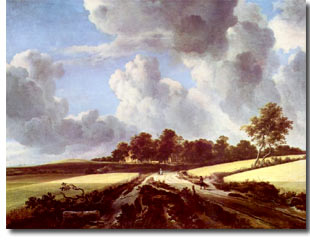
Of course, none of these painters would be considered an "imitator" of Claude or Poussin or the Dutch old-master landscapists like Jacob van Ruisdael and his circle. They each updated the old models with North American scenery and their own 19th century sensibilities. That's what artists did for centuries, until the 20th century established the cult of originality, in which works of "striking originality" were supposed to spring like Athena, fully formed, from the intense brow of the maverick individual. And today, of course, it's all about "infringement."

I still believe that studying and copying the techniques of worthy masters is the best way to learn anything. It's just sort of striking to me, I guess, that a show titled "The American Vision"can actually on closer inspection be found to owe such a serious debt to the traditional European conventions of landscape art. 

Monday, August 30, 2010

Constable's Clouds Redux & Big Dutch Skies


Here's an exciting Constable landscape that, if walked through carefully, will reveal a number of its secrets quite readily.

The name of this painting is Harwich Lighthouse, and Constable painted it around 1820 (same time as the cloud sketches in the previous post). It's from that Australian Web exhibit I told you about, and you can see their page on it here. See how he confines the sunlight to the middle ground? When you realize that the foreground shadow is from a passing cloud, you get that the lighthouse and the little fellow walking along the path are just there for scale, and this whole painting is really just an excuse to paint the sky!

The relatively few fans Constable garnered in his lifetime were blown away by the sense of place in this and other paintings, that is, by his fidelity to nature and the downright Englishness of his English countrysides. He's beloved by his nation today because ultimately his work woke up the English to the beauty and poetry of their own country.

But his early admirers also recognized in his work a then-fashionable nod to Dutch Old Master landscape painting. The Dutch were the first to establish a tradition of "pure" landscape - depictions of natural scenery free from narrative content, often with little or no human presence.


Above is a painting by Willem van de Velde the Elder (1611-1663) that to me feels similar to Constable's lighthouse painting. In both paintings, a few relatively small vertical shapes project above the horizon, which immediately gives way to the big sky and clouds. Both paintings show us objects getting smaller as they recede in space, drawing our eyes into the painting and toward that luminous line between earth (or water) and sky. Speaking of perspective, look back at the lighthouse at the top of the page. Note where your eye travels as you look at it. The coastal path takes us to the ostensible point of interest, the lighthouse, and then jags right and shoots our gaze along the line of light, right to the little ramp of land jutting up like a runway into the big wide sky, which is where Constable secretly wanted to launch our attention all along.


And this is another Dutch Old Master with a coastal (rather than marine) subject matter. As you can see, giving over two-thirds of the canvas to the sky is "very Dutch." It's clear that Constable wasn't the first to be fascinated by the dynamism of nature. Have a look at this Rembrandt, now.

Rembrandt uses what's today known as an "Old Master palette," which means it's limited to earth tones, black, and white. Though he learned a ton from the Dutch painters about painting landscapes, Constable discarded the Old Master palette, as did the Impressionists who admired Constable's work for its freshness.

Each of these paintings gives us a great sense of the vastness of sky and the beauty and volatility of the natural world we inhabit. We'll be revisiting the Old Masters many times in posts to come.