|
| Twisted! Thomas Cole's painting (right) c. 1850, is very similar in composition to that of Claude's, c. 1650, (left). They're even the same size. |
The Peabody-Essex Museum in Salem, MA, is hosting a traveling exhibition of nineteenth-century American landscapes on loan from the New York Historical Society. Salem is the only New England stop on the tour, and definitely worth a visit, if only to view the paintings by Thomas Cole (not to mention all the wonderful pagans in their witchy-warlocky-Octobery outfits). In a few days, I'll post a report on Cole's works, which includes a masterpiece series rarely shown to such advantage titled "The Course of Empire." Painting - The American Vision, closes on November 6.
But it so happened that just the day before my visit, I'd been studying the nineteenth-century English landscapists (Cole was born in England) and their relationship to the old masters, in particular their debt to Claude Lorrain.
Claude, as he's called, perfected a branch of northern European landscape painting in which the artist fashions "perfect" pastoral scenes more ideal than any in fact. As a young man, Claude led a footloose life in and around Rome, where "pure" landscapes, despite the popularity of those by Dutch masters, were frowned upon as unworthy of serious painting. Claude got around this by having small figures added to his paintings, sometimes even by other artists, thus providing a narrative pretext, often mythical, sometimes Biblical, for the imaginary scenery he loved to paint. Tastes change, and the world soon came to his doorstep, and Claude became one of the most celebrated - and imitated - landscape painters in all of history.

For proof, one need look no further than the Hudson River paintings being shown at the Peabody-Essex. Hudson River pioneer Thomas Cole is generally lauded as "the father of American landscape painting," and so he was, but in the zeal to establish the Hudson River School as the first native art movement in America, the debt to European models is often overlooked. And the more one looks, I'm afraid, the more deep that debt appears.
Claude, as he's called, perfected a branch of northern European landscape painting in which the artist fashions "perfect" pastoral scenes more ideal than any in fact. As a young man, Claude led a footloose life in and around Rome, where "pure" landscapes, despite the popularity of those by Dutch masters, were frowned upon as unworthy of serious painting. Claude got around this by having small figures added to his paintings, sometimes even by other artists, thus providing a narrative pretext, often mythical, sometimes Biblical, for the imaginary scenery he loved to paint. Tastes change, and the world soon came to his doorstep, and Claude became one of the most celebrated - and imitated - landscape painters in all of history.
For proof, one need look no further than the Hudson River paintings being shown at the Peabody-Essex. Hudson River pioneer Thomas Cole is generally lauded as "the father of American landscape painting," and so he was, but in the zeal to establish the Hudson River School as the first native art movement in America, the debt to European models is often overlooked. And the more one looks, I'm afraid, the more deep that debt appears.
Reduced to a formula, Claude's paintings (which are gorgeous masterpieces, don't get me wrong) consist of a broad, horizontal expanse of bucolic countryside pervaded by a warm, golden glow, as of evening, framed by foreground trees and tiny figures in the foreground, with the background receding dreamily into hills bathed in atmospheric violets and blues, often some water in the middle-to-foreground space.
Like his friend Nicolas Poussin, Claude's composites regularly included imaginary ruins suggestive of the pastoral tradition established by Roman writer Virgil. Not only did Thomas Cole do the same, but as shown by a comparison of the two paintings below, he adopted the whole raft of Claudian conventions, including composition, light, warm greens, and the handling of foliage.
Like his friend Nicolas Poussin, Claude's composites regularly included imaginary ruins suggestive of the pastoral tradition established by Roman writer Virgil. Not only did Thomas Cole do the same, but as shown by a comparison of the two paintings below, he adopted the whole raft of Claudian conventions, including composition, light, warm greens, and the handling of foliage.
 |
| Claude Lorrain, Landscape with Merchants, 1635 |
 |
| Thomas Cole, Dream of Arcadia, 1838 |


Even the one Inness on view (below) doesn't stray radically far from the same European motifs.

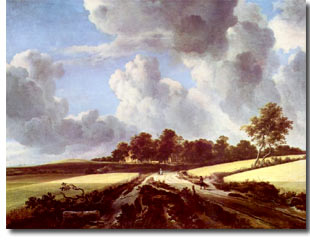
Of course, none of these painters would be considered an "imitator" of Claude or Poussin or the Dutch old-master landscapists like Jacob van Ruisdael and his circle. They each updated the old models with North American scenery and their own 19th century sensibilities. That's what artists did for centuries, until the 20th century established the cult of originality, in which works of "striking originality" were supposed to spring like Athena, fully formed, from the intense brow of the maverick individual. And today, of course, it's all about "infringement."
I still believe that studying and copying the techniques of worthy masters is the best way to learn anything. It's just sort of striking to me, I guess, that a show titled "The American Vision"can actually on closer inspection be found to owe such a serious debt to the traditional European conventions of landscape art.
I still believe that studying and copying the techniques of worthy masters is the best way to learn anything. It's just sort of striking to me, I guess, that a show titled "The American Vision"can actually on closer inspection be found to owe such a serious debt to the traditional European conventions of landscape art.