Showing posts with label Art of Seeing. Show all posts

Thursday, August 29, 2013

"Seeing like an Artist" with Charles Woodbury in Ogunquit, ME

As faithful readers know, I've been posting articles here in an arbitrary way about early 20th century landscape painter Charles Herbert Woodbury. I first became interested in Woodbury when I discovered he'd founded a once-influential plein air painting school, and indeed an entire artists' "colony," in Ogunquit, Maine, which is one town over from where I used to live in Cape Neddick, ME.

I've finally collected my thoughts on old Charles in a single place, in an article titled Painting in Verbs: Rediscovering the Art and Teaching of Charles H. Woodbury published by the Mass Humanities Council's blog, The Public Humanist.

Woodbury painting in Kittery, ME.
I used to live in Kittery too!
Having basically lived obliviously right where Woodbury painted and had his school, I was surprised by how much history I didn't know - close associations with Edward Hopper, national renown, 4,000 painting students over 40 years, even three books now out of print but full of spark and insight. 

It was all so interesting to me, largely because today there are relatively few traces in Ogunquit, where it all happened. 

As I delved into his forgotten books and unpublished notebooks, Woodbury began to emerge as an unsung hero of contemporary landscape practice who early on championed some of the basic tenets of plein air painting as it's known and loved today: Woodbury's entire philosophy of painting and teaching revolves around the now-familiar notion of "seeing like an artist." 

In his gem-studded Painting and the Personal Equation (free ebook here), Woodbury presents a little manual on active observation and perception and a working formula for capturing sensations with fresh, non-fussy painting (techniques that my own students have explored in my workshops). 

The book also provides a revealing walk-through of the exercises and assignments he used in his "Art of Seeing" school. I will be bringing some of these techniques and exercises in "seeing big" and "painting in verbs" to a week-long workshop I'm going to co-teach in Oqunquit, within view of Woodbury's still-extant 1898 studio, along with Todd Bonita during the week of September 23. 
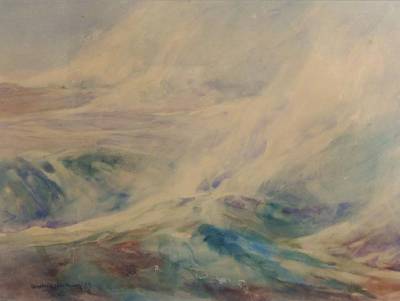
Ocean Waves by Woodbury
I'm going to be giving a free talk/lecture on Woodbury and the Ogunquit school at the York, ME Art Association on Saturday, September 7 from 7-8 p.m. and again on Monday, September 9 from 8-9 p.m. at the Manchester Art Association in Bedford, NH. It's an overview of Woodbury's life and work with an emphasis on how the "art of seeing" philosophy informed his work and how it can inspire today. You can download the slideshow as a PDF here.

All of this isn't intended to teach people to paint like Woodbury, of course. But the spirit of Woodbury's views provides jumping-off places for precisely, I think, what so many artists are looking for: inspiration for fresh, non-formulaic seeing and painting. 

It also feels like paying respect to one's predecessors. And really, it's just great to be painting outside in a place as beautiful as Ogunquit and to be "doing art history" in a way that treats it as a living thing.


Monday, June 10, 2013

Looking, Thinking, Painting

I have a friend who knows far more about art than I do, to whom I occasionally show my work (when I get up the nerve). He recently managed to soothe my oft-times fevered brow with some brief encouragement and the words, "keep looking, thinking, and painting."

Landscape by Bruce Crane (c. 1910)
"That'll happen, anyway," I thought to myself - but his words kept coming back to me with increasing gravity. Looking, thinking, and painting. 

Actually, what else is there? Doing just these three things with intense passion, thoughtfulness, and dedication are precisely what's required of a good painter. 

Richard Diebenkorn, Cityscape, 1963

From here, there are many different ways to go. Personally, I tend to think a lot about painting (why I love art history and why I write this blog). It seems to me that the purpose of painting is not simply to produce a more or less "faithful" copy (faithful to what, exactly?) of something (a particular tree in a particular hilly field, or a particular cityscape in California, for example). We have cameras for that. I believe with Charles Woodbury that “a picture is a thought or feeling expressed in terms of Nature.” The rest of that sentence reads: “The method is a matter of the moment….Clear sight, clear thought, clear expression; the thought should depend on the sight, and the expression on the thought.” Sight, thought, and expression = looking, thinking, and painting = "observations, concentration then application," so said Frederick Waugh as well.

You probably already believe, as I do, that painting has more to do with seeing than with technique. Let's face it, the technique of painting is much easier to learn than the lifelong task of knowing oneself. I think one of painting’s amazing qualities is how it “opens our eyes” to our role in creating meaning via the links between "sight, thought, and expression."

Winslow Homer, Artists Sketching in the White Mountains

I'm turning this over in my mind because I'm going to be teaching a plein-air workshop at Crawford Notch in the White Mountains next week (Monday & Tuesday, June 17 & 18). Mindful that it’s probably not possible or even desirable to consciously control the whole process while immersed in the act of painting itself, this three-tiered foundation will be our premise and our guide. Seeing with fresh eyes is the essential first tier; thought, the subjective response, follows from the initial perception; technique serves to express the artistic experience.

Titian, Rape of Europa (detail)

I get more excited thinking about teaching people to use painting as a means of heightening perception, deepening self knowledge, and becoming a more fully realized person than I do thinking about teaching technique. 


Brice Marden, Vine, 1992-93

Do you teach technique or artistic seeing? A little of both? As we all know, it’s entirely possible for students to follow the principles of freedom and self-expression and to produce failed paintings, concluding (almost certainly wrongly) that they have no talent. The reason for this, I think, is that painting, like any creative act, implies an audience (even if only of one), and therefore one must balance the freedom of personal expression with technical means and with a related aesthetic (e.g. "loose," impressionistic, realist, tonalist, semi-abstract, etc.), a manner or style either consciously chosen or inherited. 

Antonio Lopez-Garcia, The Dinner, 1971-80

Alternately, many students of painting believe they are “learning to paint” when they are merely learning the techniques behind a particular painter’s aesthetic. I don't want to teach technique or a particular aesthetic approach, but I do want to teach students how to make "good paintings." Am I wrong to sense that this depends on something separate from, maybe prior to, technique? I want  my students to be very happy with their paintings, but I want them to really be their paintings.

A RAVISHINGLY SEEN and painted landscape by John Singer Sargent

What are your thoughts on teaching and learning to paint? What do you think of the idea of breaking it down into "clear sight, clear thought, clear expression" - looking, thinking, painting?


Wednesday, April 24, 2013

The Art of Seeing in Ogunquit, Maine

Tidal Rocks, Ogunquit
Nine students joined me for a fabulous day of painting, history, and self-exploration at my April 19 plein-air workshop last week in Maine.

We met at a coffee shop in Perkins Cove to set the tone for the day - we would use 20th century Maine seascape painter Charles Woodbury's theories on the "Art of Seeing" as a way of opening our work to greater feeling. If you wish, you can download a copy of our handout of Woodbury quotes from my website's workshops page.

Flyer for Woodbury's
Art of Seeing classes
Charles Herbert Woodbury (1864-1940) made our workshop location a famous plein-air painting spot during the first half of the 20th century. From his cliff-face studio, which has been carefully preserved and restored, Woodbury taught literally thousands of painters what was then a radical idea: don't paint it the way it looks, paint it the way it "seems." He was perhaps the first teacher to formalize a practical method of emphasizing feeling over academic skills in plain-air painting. 

As Woodbury had his students do, I demonstrated a method for painting very quickly out-of-doors: take stock of the visual field as whole, and don't just look at but feel the value-relationships you see, especially at the edges of the big things - land, sea, and sky. 

Then quickly fill your canvas with four or five flat color-values, fitting them together like a puzzle. The key was not trying to imitate this or that actual color in nature, but to relate color-values to each other on the canvas according to to our initial, spontaneous reactions to nature. 

Accomplishing that, the rest is technique - one may make the painting as detailed as one might wish, but the general rule is to only add as much detail as is necessary before it begins to detract from the big simple "great things" seen and noted at the outset.

After lunch (lobster rolls for some of us, simpler, less tentacled fare for others), everyone scouted out their own motifs and once more applied the "Woodbury method." As one of the students remarked, every single one of those paintings had it - that elusive thing without which even the most technically accomplished paintings stand or fall: real seeing and feeling.

Discussions with the Beth Ellis Gallery in Perkins Cove are continuing, with plans for a week-long "Art of Seeing" workshop in partnership with the gallery in September. Stay tuned for dates and shoot me an email if you'd like to reserve a space.

Tuesday, April 9, 2013

Seeing Big in Perkins Cove


Charles H. Woodbury used to tell the students in his Ogunquit, Maine Art of Seeing class to "paint big and fast outside" not because drawing doesn't matter (it does) but to help them capture their initial felt impressions of nature first. 

I love the runaway red in this painting, one of Woodbury's more Modernist-influenced works.

At 17, while an engineering undergrad at MIT, Woodbury became the youngest artist ever elected to the prestigious Boston Art Club. Critics recognized in his first solo show (which sold out - he was 18) the hallmarks of his life's work: a sensuous love of paint, a sharp observational eye, a sense of air and light, and, above all, a feeling for the world of "things" as the interaction of forces and resistance in motion. 

Cliffs at Ogunquit

Even though he'd decided he wasn't going to become an engineer (he was already supporting himself by teaching and selling his art), Woodbury was determined to finish MIT for the sheer challenge of doing so. He fell in love with one of his art students, a southern Mainer by the name of Susan (Marcia) Oakes. He stumbled on Ogunquit while visiting "Miss Oakes," and after they married he built a studio and a house for them and set up shop. In 1898 he established his summer art school, which he operated for the next 40 years under the banner of "The Art of Seeing." 

He was one of the earliest painters to teach what has become a core tenet of contemporary plain-air painting: active seeing, or "seeing like an artist," as it's often phrased.

Woodbury's view from his studio, a painting he titled "Phlox." Though thoroughly Impressionistic in influence, it illustrates Woodbury's sense of things as forces in motion. "Paint in verbs not in nouns," he told students.

Woodbury constructed a painting very quickly out of four or five flatly painted "color values" that corresponded to his spontaneous reaction to nature. "Be deliberate," he advised. "Size up the whole day and conditions.... Then paint as though you had been sent for. You cannot afford to lose a second anywhere – not a second." After that, his procedure was to take the painting to completion with only as much detail as he felt he could add before it began to take away from the "great things" that were there at the start.

Woodbury was more practical than visionary; he chose traditional representation at a time when abstract art was breaking the new ground. He didn't ignore Modernism completely, he just took bits and pieces of it here and there as it suited his purpose. 

There's a good bit of Modernist abstraction in the muscular contortions of these Ogunquit cliffs.

Much of his work combines "Impressionism, oriental compositional motifs, and the sensuous lines and jewel-like colors of the Art Nouveau," as art historian Erica E. Hirschler correctly nailed it.

But his greatest influence came through his teaching. Before Woodbury's death in 1940, some 4,000 painters passed through his "Art of Seeing" summer program. The "colony"that sprang up around the school also drew important artists, including Edward Hopper, Robert Henri, Hamilton Easter Field, Robert Laurent, Marsden Hartley, George Bellows, and Walt Kuhn.

The "sensuous lines and jewel-like colors of the Art Nouveau."

“A picture is a thought or feeling expressed in terms of Nature," he wrote. "The method is a matter of the moment….Clear sight, clear thought, clear expression; the thought should depend on the sight, and the expression on the thought....Realism is not based on the way things are, but upon things as you see and feel them. Realism is after all only what you think the thing may be.”

What I like about Woodbury is his rejection of painting as simple imitation in favor of an expressive perceptual approach. He's rooted as much in love for the medium as in the desire to see clearly with the heightened perception of the fully present eye and mind. 

Often eliminating foreground cues, Woodbury originated a convention in marine painting in which the viewer is suspended in mid air above the waves.

Woodbury's "Thunderstorm." Before 1940, landscape painting didn't get much more direct and gestural than this.

For my students and other folks nearby: Through a series of presentations and painting workshops, I hope to help share Woodbury's work and his approach to getting "the big things" in nature with a new audience. I want to see if, by "seeing big," we can capture spontaneity and originality in paintings that work. 

I'll be giving a free presentation on Woodbury and his teaching philosophy at the Beth Ellis Cove Gallery in Perkins Cove (within sight of Woodbury's original 1898 studio) this Sunday, April 14, at 2 p.m. You can download a preview of the presentation from my website: http://christophervolpe.com/exhibitions-galleries/

The presentation came about because of a one-day workshop I'm conducting in Ogunquit on the 19th in which we'll take inspiration from Woodbury's approach to seeing and painting. There's still space for a few more - let me know if you're interested in joining us.

In the planning is a week-long course in Woodury's "Art of Seeing" that I'll offer jointly with painter Todd Bonita through the Beth Ellis Cove gallery in September.

Ogunquit headlands.