Showing posts with label workshops. Show all posts

Monday, April 3, 2017

The Scottish Highlands Call

I’ll be leading a plein air workshop in the Scottish Highlands during the week of October 8th - October 13th, 2017. We'll be painting and staying near Inveraray Castle, which was featured in an episode of "Downton Abbey." 
As for painting locations, in addition to the castle grounds and the impressive loch, locals we’re in touch with are ready to show us the best, easy hiking trails through ancient woods, over hills dotted with ruins, opening out on amazing views.
We will take inspiration from the rolling hills, mountains, lakes, valleys, and coasts of the Scottish Highlands, which have captivated artists for hundreds of years. High Romantics who’ve preceded us, such as Wordsworth, Keats, Byron, Mendelssohn, and J.W.M. Turner, will be our spirit guides. We’ll be headquartered at and around the Duke of Argyll's castle, near the picturesque small quaint town of Inveraray, perched beside Loch Fyne, the largest loch in the country.


The final day, reserved  for exploring, painting solo, or joining the planned sketching trip to Fingal's Cave, will also include stops at Oban and Islay, about three hours to the west.

The workshop fee of $1,650 includes accommodations in a beautiful waterfront cottage, four full days of painting instruction and an optional sketching trek, and daily tea at Castle Inveraray with the Duke and Duchess of Argyll.

This workshop is filling and will fill be full soon, so if you’re interested, shoot me an email and let me know right away.


GO HERE FOR ADDITIONAL DETAILS


Fingal's Cave


Monday, October 13, 2014

Painting in the White Mountains - Field Report

View of Crawford Notch from our base at the AMC Highland Center
The White Mountains, arguably the east coast's most "sublime and picturesque" terrain, have never ceased to fascinate lovers of the outdoors. So it makes sense that some of nature's most rapt admirers - landscape painters - are coming back as they once did to explore the Whites in their art.

The AMC Highland Center at Crawford Notch.
A couple of weeks ago, six men and women joined me for a three-day beginners-welcome workshop at the AMC Highland Center, a wonderful, hotel-like lodge at the base of Crawford Notch in the White Mountain National Forest. . From Sunday till Tuesday all we did was get up in the morning, have an all-you-can-eat breakfast, and walk out the door, set up, and start painting. There were easy hikes to elevated viewpoints and a van at our disposal to take us anywhere in the Whites, but who needs them when everywhere you look there's a painting to be made? We'd break for lunch, paint until 4, and then we'd all meet at 6 for the gourmet dinners served family style complete with beer, wine, and freshly baked bread. 

Painting at the edge of Saco Lake, across the street from the Highland Center.

After dinner the first night I gave a slide talk on the history of White Mountain painting. The next day we painted from a different side of the lodge and that evening we watched Brush and Pen, Artists and Writers of the White Mountains, a documentary on White Mountain history, art, and literature.

The inaugural AMC Highland Center Crawford Notch Artist in Residency was an unqualified success. In a wonderful circularity, two of the participants in the first revival of the Crawford Notch residency - Lisa Shapliegh-Koepke and her mother Elizabeth - were actually descendants of the same Shapleigh family as was the site's original artist-in-residence Frank Henry Shapleigh. 

Frank Henry Shapleigh

Frank Henry Shapleigh's restored 19th century studio building, part of the Highland Center.

Frank Shapleigh was artist-in-residence for 16 years from 1877-1893 at the Crawford House, one of the grandest of the grand hotels, the abandoned hulk of which burned to the ground in 1977. 

Early engraving of the original Crawford House

The Crawford House in its heyday.

Crawford House in 1977, the summer before the fire.

At the age of 86, Elizabeth was an inspiration to us - despite using a walker to get around, she wasn't held back at all and painted with us in all of the locations (it's that easy to find spectacular scenery to paint within easy walking distance of the lodge).

The unstoppable Elizabeth Shapleigh (age 86).

My rendering of the gate of the Notch from Saco Lake.
On Tuesday afternoon, after the official close of the workshop, I hiked up 2,864' Mount Willard (the trailhead is right there). I invited folks from the workshop to join me and three took me up on it. I brought my paint kit so I could sketch the same view that Shapleigh famously painted.

Shapleigh's view from Mount Willard

My photo from roughly the same spot as Shapleigh's painting.

 The view was unbelievable and more than worth the effort of the hike, which wasn't all that bad actually, even with a 30-pound paint kit on my back. The sketch doesn't look like much, but it's got the information I need to build a study and then I can work from there on something larger.

My sketch of the valley of the Notch.

I was fascinated by this peak, and I still want to paint it.


This was nearby but we didn't end up painting it. Next time!
Burning Off, an 8" x 10" I painted from outside the Highland Center

I'm hoping the AMC Crawford Notch residency will become an institution of American plein air painting. The idea is to invite artists from all over the country - plein air painters, mostly - to spend a week in residence at the Highland Center. Each artist will conduct a painting workshop for a set portion of the week and is also encouraged to present an evening program, a talk or presentation, of some kind.

A White Mountain landscape, c. 2013, by contemporary painter Eric Koeppel. 

I think it's great that plein air painting is surging in popularity. The secret is out: oil painting is no longer the difficult, smelly, esoteric, highly specialized art it once seemed. With terabytes of free how-to videos and web texts online, getting started and learning the basics is the easiest it's ever been in the history of the world. It is only a matter of time before the rich history of American landscape painting again becomes common knowledge.

Who knows but a new era of White Mountain painting may even now be on its way?

THE CREW: (L-R) Volpe,  Carrie Masci, Ann Marie Corbett, Lisa Koepke, Elizabeth Shapleigh, Catherine Bickford, David Kimball

Thursday, August 29, 2013

"Seeing like an Artist" with Charles Woodbury in Ogunquit, ME

As faithful readers know, I've been posting articles here in an arbitrary way about early 20th century landscape painter Charles Herbert Woodbury. I first became interested in Woodbury when I discovered he'd founded a once-influential plein air painting school, and indeed an entire artists' "colony," in Ogunquit, Maine, which is one town over from where I used to live in Cape Neddick, ME.

I've finally collected my thoughts on old Charles in a single place, in an article titled Painting in Verbs: Rediscovering the Art and Teaching of Charles H. Woodbury published by the Mass Humanities Council's blog, The Public Humanist.

Woodbury painting in Kittery, ME.
I used to live in Kittery too!
Having basically lived obliviously right where Woodbury painted and had his school, I was surprised by how much history I didn't know - close associations with Edward Hopper, national renown, 4,000 painting students over 40 years, even three books now out of print but full of spark and insight. 

It was all so interesting to me, largely because today there are relatively few traces in Ogunquit, where it all happened. 

As I delved into his forgotten books and unpublished notebooks, Woodbury began to emerge as an unsung hero of contemporary landscape practice who early on championed some of the basic tenets of plein air painting as it's known and loved today: Woodbury's entire philosophy of painting and teaching revolves around the now-familiar notion of "seeing like an artist." 

In his gem-studded Painting and the Personal Equation (free ebook here), Woodbury presents a little manual on active observation and perception and a working formula for capturing sensations with fresh, non-fussy painting (techniques that my own students have explored in my workshops). 

The book also provides a revealing walk-through of the exercises and assignments he used in his "Art of Seeing" school. I will be bringing some of these techniques and exercises in "seeing big" and "painting in verbs" to a week-long workshop I'm going to co-teach in Oqunquit, within view of Woodbury's still-extant 1898 studio, along with Todd Bonita during the week of September 23. 

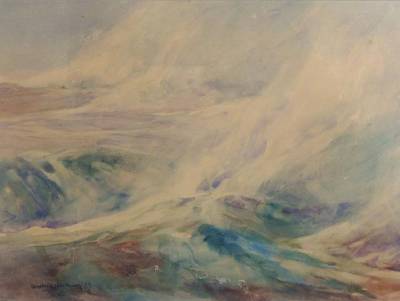
Ocean Waves by Woodbury
I'm going to be giving a free talk/lecture on Woodbury and the Ogunquit school at the York, ME Art Association on Saturday, September 7 from 7-8 p.m. and again on Monday, September 9 from 8-9 p.m. at the Manchester Art Association in Bedford, NH. It's an overview of Woodbury's life and work with an emphasis on how the "art of seeing" philosophy informed his work and how it can inspire today. You can download the slideshow as a PDF here.

All of this isn't intended to teach people to paint like Woodbury, of course. But the spirit of Woodbury's views provides jumping-off places for precisely, I think, what so many artists are looking for: inspiration for fresh, non-formulaic seeing and painting. 

It also feels like paying respect to one's predecessors. And really, it's just great to be painting outside in a place as beautiful as Ogunquit and to be "doing art history" in a way that treats it as a living thing.


Wednesday, April 24, 2013

The Art of Seeing in Ogunquit, Maine

Tidal Rocks, Ogunquit
Nine students joined me for a fabulous day of painting, history, and self-exploration at my April 19 plein-air workshop last week in Maine.

We met at a coffee shop in Perkins Cove to set the tone for the day - we would use 20th century Maine seascape painter Charles Woodbury's theories on the "Art of Seeing" as a way of opening our work to greater feeling. If you wish, you can download a copy of our handout of Woodbury quotes from my website's workshops page.

Flyer for Woodbury's
Art of Seeing classes
Charles Herbert Woodbury (1864-1940) made our workshop location a famous plein-air painting spot during the first half of the 20th century. From his cliff-face studio, which has been carefully preserved and restored, Woodbury taught literally thousands of painters what was then a radical idea: don't paint it the way it looks, paint it the way it "seems." He was perhaps the first teacher to formalize a practical method of emphasizing feeling over academic skills in plain-air painting. 

As Woodbury had his students do, I demonstrated a method for painting very quickly out-of-doors: take stock of the visual field as whole, and don't just look at but feel the value-relationships you see, especially at the edges of the big things - land, sea, and sky. 

Then quickly fill your canvas with four or five flat color-values, fitting them together like a puzzle. The key was not trying to imitate this or that actual color in nature, but to relate color-values to each other on the canvas according to to our initial, spontaneous reactions to nature. 

Accomplishing that, the rest is technique - one may make the painting as detailed as one might wish, but the general rule is to only add as much detail as is necessary before it begins to detract from the big simple "great things" seen and noted at the outset.

After lunch (lobster rolls for some of us, simpler, less tentacled fare for others), everyone scouted out their own motifs and once more applied the "Woodbury method." As one of the students remarked, every single one of those paintings had it - that elusive thing without which even the most technically accomplished paintings stand or fall: real seeing and feeling.

Discussions with the Beth Ellis Gallery in Perkins Cove are continuing, with plans for a week-long "Art of Seeing" workshop in partnership with the gallery in September. Stay tuned for dates and shoot me an email if you'd like to reserve a space.