Showing posts with label cezanne. Show all posts

Monday, September 14, 2015

Cezanne & Pissarro in Pontoise

This morning I spent a fascinating hour or two contemplating images of paintings by Cezanne and Pissarro side by side, as they were when the two artists created them together in a Paris suburb beginning in the early 1860s.


Such different approaches to the same scene ... Cezanne left, Pissarro right.


Perhaps by necessity, they were rebels, bohemians, outsiders both, intent on shattering prevailing ideas about painting and about beauty. Newly arrived in Paris at the age of 22, Cezanne played the provocateur, flaunting his outsider, country-bumpkin status like a hipster in flannel and a lumberjack beard (or, as an astute New York Times reviewer of the show lovingly described him, "a furious misfit with the face of a hobbit, the mind of a scholar, and the mouth of a (dockworker).". He'd been packed off to Paris to study law, but instead he enrolled in painting classes at a walk-in art school.

Cezanne, left, Pissarro right, same delft vase.

Jacob Abraham Camille Pissarro was a Dutch citizen, a Jew born in the West Indies, who grew up learning French in an all-black school; he was shunned by the local rabbi because his father'd come to the island to deal with the estate of a deceased uncle and ended up staying and marrying the man's creole widow (his niece by marriage). Pissarro was one of the few artists or students in Paris who didn't either avoid, disparage, or make fun of Cezanne, so friends and allies they became.

Cezanne (l.), Pissarro (r.)

Pissarro was nine years older than Cezanne, a restless innovator with a single-minded drive to redefine painting that would eventually allow scholars to recognize him as the "pivotal" figure in avant-garde painting of the time. He sought out radical teachers like Courbet, settling eventually on Corot, but soon outgrew the soft focus approach with work that had the plein-air plainness of Daubigney - and "the future geometry of Mondrian" (Cotter).


Cezanne (l.), Pissarro (r.)

Pissarro afterward anchored and unified the young Impressionists, including Monet, Manet, Renoir, and Degas, and then pushed into the new territory of Post Impressionism, a father figure to Seurat, Cezanne, van Gogh, and Gaugin. Cezanne's work fits into the Modernist narrative as a turning away from Impressionism, but Cezanne was working it out with Pissarro as early as 1866 (the first Impressionist exhibition wasn't until 1874).

Again, same houses.

In Pontoise, the Paris suburb where Pissarro lived, the two painters often painting the same motif, sometimes in fundamentally different ways, a bit like Picasso and Braque, who together invented Cubism, picking up where the earlier odd couple left off ("My one and only master," Picasso called him, "Cezanne was like the father of us all").
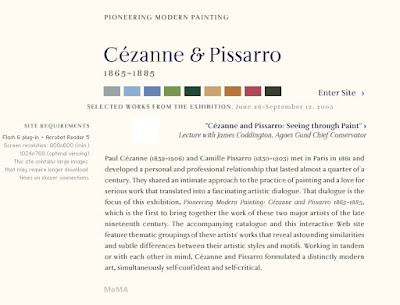

Although the exhibition of 2006 has come been and gone, the Museum of Modern Art keeps a wonderful interactive catalogue parked on their website that's well worth poking around in. It's even got details of the brushwork of each painting. The article I cited above by Holland Cotter's great too.


Saturday, February 16, 2013

Cezanne's Magnificent Bathers, Part 1

Cezanne, The Bathers (1898-1906)
During the last 20 years of his his solitary life, isolated and immersed in his work, Paul Cezanne reinvented painting as a crucible in which to experiment with new combinations of sensation and representation.

In his many paintings of "bathers" - mostly nude women and men lounging beside alluvial scenery -  Cezanne achieves a mature synthesis of psychology, private symbolism, tradition, spontaneity, and joyous color and light. A masterpiece of early modernism, The Bathers, also known as "The Large Bathers" because of its size, from 1906. is currently in Boston, on loan from Philadelphia and on display at the MFA. The museum is pairing this painting, on which Cezanne worked during the last six years of his life, with another large-scale important work of post-Impressionism, Gaugin's epic Where Do We Come From? What Are We? Where Are We Going? 

Gaugin, Where Do We Come From? What Are We? Where Are We Going? (1891)
It's hard not to see each of the paintings as culminations of these great artists' careers: last testaments to the world on a monumental scale. To see them both on one wall is a once-in-a-lifetime treat (and then, of course, turn your head and to the left and you're viewing gorgeous Monets, to the right it's masterworks by Van Gogh - not bad!). 

Cezanne saw Impressionism as liberating but too superficial. He had emerged from the introspective personal mythology of his early work ready to embrace Impressionism's light and color, but he wanted to make out of it something more solid, more "permanent," he said. 

Melding the movement's freedom from the Academic rules of painting with the firm construction and solidity of the more enduring art "of the museums" committed him to objects and vision. The irony is, that despite believing he was an ultra-honest realist in the service of Truth, the work he created, with its deliberately interpenetrating surfaces, objects, spaces, and paint, set the stage for abstraction and modern art; as blogger John Haber has succinctly observed, without Cezanne, "the art of the next century (the 20th) becomes incomprehensible."

To see what he means, one has only to turn to Picasso's Les Damoiselles D'Avignon, painted in 1907. 

Picasso, Les Damoiselles d'Avignon, 1907
This painting changed art forever. It was here, trading in nymphs for prostitutes, Renaissance perspective for shattered space, the Greek ideal for a jarring, brutal quasi-primitivism, that Picasso outstripped the last remaining vestiges of traditional European representation and reinvented art's role as a daring reflection of our uncertain times. Inadvertently setting the stage for Cubism and all that it would mean to modern art, Picasso's work was conceived as an acerbic response to Matisse's La Joie [bonheur] de Vivre, completed in 1906 (note the two female figures with identical poses, arms folded behind their heads). 

Matisse, La Bonheur de Vivre, 1905-06
The idealized utopianism of Matisse's conception ("natural" men and women depicted with a childlike exuberance freely loving, dancing, and existing in a beautiful, bright simplicity) was in turn a direct answer to the Bathers of Cezanne.

And that's all we have time for today..... the art-historical-high-fallutin' artspeak of this post has worn me out already, so a fuller treatment of Cezanne's masterpiece will have to wait until next time.