Showing posts with label Impressionism. Show all posts

Thursday, May 25, 2017

George Hendrik Breitner - Dutch "Impressionist"


Art historians call George Hendrik Breitner (1857-1923) one of the "Amsterdam Impressionists." However, his paintings don't align with the kind of artwork commonly associated with Impressionism. Yet, his approach to painting arguably remained more authentic and true to the basic tenets of the movement than his better-knows French compeers like Monet, Renoir, and Pissarro. 


One of Impressionism's guiding principles (inherited from the Barbizon painters of the 1830s) was the direct, unmediated depiction of contemporary life. For the pioneering Barbizon painters, that meant rejecting official Academic painting and turning to the observed rural landscape and the life of the "common" people who worked the land. 

In contrast, the French Impressionists largely focused on the urban scene, and, as did leading American Impressionists, often on the leisure activities of the middle- and upper-classes. They also strayed from realism (though they'd argue they were being faithful to how vision actually processes what the eye takes in, according to the new science of optics and color) by way of technical developments such as the translation of light into broken color (the reason for the characteristic flecks and dots of paint). 


Breitner, like others in the Dutch Hague School, seems to have digested the basic premise of painting life as at is really lived and seen but rejected the technical flash and polish of the French school as a too-sophisticated mannerism for contemporary life in all its jumbled, gritty reality. The paintings he made remain startlingly fresh and gloriously un-idealized.


According the Rijksmuseum, "Breitner was born in Rotterdam. In 1876, he enrolled at the academy in The Hague. Later, he worked at Willem Maris's studio. In this early period he was especially influenced by the painters of the Hague School. Breitner preferred working-class models: laborers, servant girls and people from lower-class neighborhoods. He saw himself as 'le peintre du peuple', the people's painter. In 1886, he moved to Amsterdam, where he recorded the life of the city in sketches, paintings and photos. Sometimes he made several pictures of the same subject, from different angles or in different weather conditions. Photos might serve as an example for a painting, as for his portraits of girls in kimonos, or as general reference material. Breitner often collaborated with Isaac Israels; both painters are referred to as Amsterdam Impressionists. Conservative critics called Breitner's style 'unfinished'."


He also took powerful photographs and worked with them for reference. The Rijksmuseum has a nice selection of his work on this page.

Monday, September 14, 2015

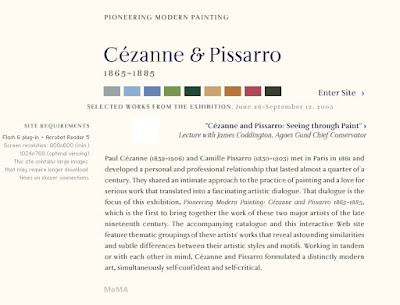
Cezanne & Pissarro in Pontoise

This morning I spent a fascinating hour or two contemplating images of paintings by Cezanne and Pissarro side by side, as they were when the two artists created them together in a Paris suburb beginning in the early 1860s.


Such different approaches to the same scene ... Cezanne left, Pissarro right.


Perhaps by necessity, they were rebels, bohemians, outsiders both, intent on shattering prevailing ideas about painting and about beauty. Newly arrived in Paris at the age of 22, Cezanne played the provocateur, flaunting his outsider, country-bumpkin status like a hipster in flannel and a lumberjack beard (or, as an astute New York Times reviewer of the show lovingly described him, "a furious misfit with the face of a hobbit, the mind of a scholar, and the mouth of a (dockworker).". He'd been packed off to Paris to study law, but instead he enrolled in painting classes at a walk-in art school.

Cezanne, left, Pissarro right, same delft vase.

Jacob Abraham Camille Pissarro was a Dutch citizen, a Jew born in the West Indies, who grew up learning French in an all-black school; he was shunned by the local rabbi because his father'd come to the island to deal with the estate of a deceased uncle and ended up staying and marrying the man's creole widow (his niece by marriage). Pissarro was one of the few artists or students in Paris who didn't either avoid, disparage, or make fun of Cezanne, so friends and allies they became.

Cezanne (l.), Pissarro (r.)

Pissarro was nine years older than Cezanne, a restless innovator with a single-minded drive to redefine painting that would eventually allow scholars to recognize him as the "pivotal" figure in avant-garde painting of the time. He sought out radical teachers like Courbet, settling eventually on Corot, but soon outgrew the soft focus approach with work that had the plein-air plainness of Daubigney - and "the future geometry of Mondrian" (Cotter).


Cezanne (l.), Pissarro (r.)

Pissarro afterward anchored and unified the young Impressionists, including Monet, Manet, Renoir, and Degas, and then pushed into the new territory of Post Impressionism, a father figure to Seurat, Cezanne, van Gogh, and Gaugin. Cezanne's work fits into the Modernist narrative as a turning away from Impressionism, but Cezanne was working it out with Pissarro as early as 1866 (the first Impressionist exhibition wasn't until 1874).

Again, same houses.

In Pontoise, the Paris suburb where Pissarro lived, the two painters often painting the same motif, sometimes in fundamentally different ways, a bit like Picasso and Braque, who together invented Cubism, picking up where the earlier odd couple left off ("My one and only master," Picasso called him, "Cezanne was like the father of us all").


Although the exhibition of 2006 has come been and gone, the Museum of Modern Art keeps a wonderful interactive catalogue parked on their website that's well worth poking around in. It's even got details of the brushwork of each painting. The article I cited above by Holland Cotter's great too.


Friday, August 27, 2010

Constable: Head in the Clouds


Here is an oil sketch (painted as a study, thus not intended as a finished work) by the 18th/19th century English landscapist John Constable. It’s not a masterpiece of Western art, but it’s a lovely thing, and it’s a chance for us to consider what painting is all about in the first place.


Our last painter, Corot (“ka-ROH”), was among a group of artists who were the first to regularly go outside and pitch their easels in front of nature. Like Constable, they used the oil sketches they made outdoors to paint larger works in the studio, and it wasn’t until the impressionists who followed them a little later in the nineteenth century (just when an abundance of synthetic pre-mixed colors was becoming available in portable tubes) that oil paintings executed on the spot were valued and exhibited as finished paintings in their own right.


The earlier Old Master painters usually minimized their personal presence in the work by erasing their brushstrokes and finishing their paintings with a seamless, sometimes enamel-like surface. For these traditional landscape artists, it was important to be more classical and fanciful than realistic. They often incorporated highly structured compositions, clearly defined details, and “grand” and elevating subject matter referring to stories from Greek and Roman mythology or the Bible.


All that changed with the Barbizon painters and the Impressionists who followed them. Impressionists like Monet, Renoir, and Sisely applied to the festive, modern life of Paris Barbizon’s spontaneity and fidelity to nature, its rapid, rough-and-ready brushstrokes, and its embrace of "everyday” subject matter. But some definite first steps in this direction were taken by our Englishman.


At the same time that Corot was making oil sketches en plein air (in the outdoors) in the French Barbizon countryside, English painter John Constable (1776-1837) was doing the same thing in England, but it wasn’t only the momentary effects of light on water or wind in the trees he was after (though he loved everything rural, from weathered brickwork to old rotten posts). What really mattered to Constable was the clouds.


Constable so loved the clouds that he executed dozens (if not hundreds?) of these meticulously observed and accurately rendered cloud studies. The finished landscapes his clouds adorned forever changed the course of art, but because the sketches are so fresh, so full of varied light, texture, and motion, not to mention so freely painted, they hold for us moderns a special charm. Constable devoured the work of pioneering meteorologist Luke Howard, the first to classify the various types of clouds, and his cloud paintings today would sell for tens (and possibly hundreds) of thousands of dollars. Per the usual cliches, Constable's parents opposed his career choice, the public didn't buy his pictures, and the artist remained a pauper all his life, however professedly happily so (he turned down a chance to promote his work in France saying he’d rather remain “a poor man [in England] than a rich man abroad”).


But hey, who wouldn’t be happy spending a life painting clouds!?


Paintings, then, are supposed to “ennoble our sensibilities” (Old Master), quicken our sense of the true (Barbizon), ground us in the beauty of the simple (Constable), awaken us to the life and color of the ordinary (Impressionism) …. So what’s the purpose of painting? What a silly question!


We'll surely revisit Constable's sketches and his famous finished paintings again. There's a great Web exhibit on the Australian National Gallery's Website, which is where I found the images and some of the information for this post.


Oh, and did you know there is an official "Cloud Appreciation Society" that you can join? Check out their fun (if you read it carefully) website for some really awesome images.