Thursday, January 26, 2012

The Most Beautiful Painting in the World... According to Proust


Jan Vermeer's View of Delft (1660-1661) may just be a perfect landscape painting. Once you've really looked at it, you realize it's the kind of thing you don't forget, that you could spend hours - a lifetime! - dreaming over it and still not have your fill. I've never seen the actual painting, but I'm captivated by the images of it that I've seen.

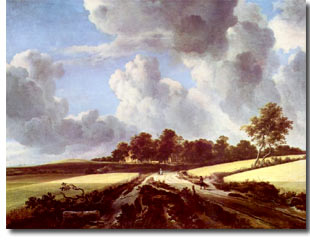
No great painting emerges out of pure invention, and Vermeer was building upon the solid foundations of the Dutch landscape tradition. We can see this in the painting's scale, its low horizon line, the overall color and luminosity, and the big cumulus clouds casting their shadow on the waterfront while the area awash in sunlight peeps out behind. Here's a landscape by Van Ruisdael that puts the foreground in cloud shadow.

Jacob Van Ruisdael, Wheat Fields, 1671
Yet, the poise, charm, and energy of Vermeer's design makes View of Delft unique. It's got an incredible degree of balance and integration between highly varied yet somehow harmonious elements!

It's arranged in a series of broad and irregular horizontal bands,"counterbalanced by smaller varied vertical units" (I'm relying for most of this on A.C. Barnes's analysis which appears as an appendix to his quirky yet rigorous The Art in Painting). And this series of graceful rhythmical divisions and subdivisions interpenetrate and integrate with each other so as to unify the whole.

Radiography shows that Vermeer deliberately extended the reflections to the extreme right, the effect of which is to unify top and bottom and further anchor the whole design.

The cloud band forms "a series of three predominately vertical units; the row of buildings and trees is rhythmically subdivided by a more pronounced and varied pattern of upright elements, the gables, steeples, towers.

The reflections in the water carry the subsidiary vertical elements of the pattern to the area of the canal, and the figures (there are 15), the two posts, and the prow of the ship function likewise in the foreground bank." (Barnes, p. 455)

Each band's color notes contrast with those of the band it touches, and the general color tone thus produced for each area of the painting (the sky, the blue-red-green masses in the center, the water, the bank) contrasts with and sets off that of its neighbors.

Throughout, the drawing, which is accomplished through color and light, is expressive and not overwrought, highlighting the essential character of each aspect of the subject, whether the sun-baked brick, the green masses of  trees, the slightly blurred reflections, the figures, or the space-relationships between the elements. 


A treatise could be written on the how Vermeer expressed "the theme of blue and red, varied with minor motifs of gray and green," in the row of buildings and trees. The color notes are predominately an earthy red and a blue "of extraordinary sensuous and structural quality, which is the key-note in this part of the design, and indeed is so powerfully eloquent as to be chiefly responsible for the individuality of the entire picture." (ibid)

French novelist Marcel Proust pits the exquisite beauty of one minute detail of the painting against the life of a character in one of his stories. The painting wins.

For a delightful commentary on Proust's use of the painting, along with the relevant excerpt, you have to check out this person's blog entry (and don't miss the comment on Aldous Huxley's pick for the most beautiful painting in the world.) 

Friday, December 9, 2011

How to Be Original

Aspiring artists often imitate an admired artist’s style. It's a great way to learn to paint and permanently  adds to one’s store of available techniques. 


Rembrandt. Self-portrait. 1666
Paradoxically, in most cases the admired work ultimately came to the admirer’s attention because it resonated with enough people as unique, deep, or original.... So not only the technique but the quality of originality itself can inspire emulation without one even realizing what one's actually responding to. And of course we prize originality in art over imitation. All artists probably have to some degree a desire to express their own unique vision of the world; presumably, over the course of artistic development, emulation ceases to be as powerful a force.


Robert Henri. Figure in Motion. 1913.
It’s like American culture - too often we emulate others who we imagine are enjoying “the good life” by wishing we were (or actually trying to become) as wealthy as we think those other people are. But it's really the wrong goal - that is,  it's a goal that isn’t really suited for what we want to achieve. 


Instead of focusing on becoming as wealthy or secure as we believe “the beautiful people” to be, we should try to focus on our ability to deeply enjoy our present life first. We will then have achieved the desired end without even trying. So with art. 


Would-be artists often begin by emulating the style of a particular artist or group of artists (plein-air painters who emulate aspects of the Rockport or the Impressionist style, say). Later, through the doing, comes one's own unique style. 


Says Robert Henri in the invaluable The Art Spirit: "Don't worry about your originality. You could not get rid of it even if you wanted to. It will stick to you and show you up for better or worse in spite of all you or anyone else can do."


Monet. Water lilies. (detail)
I think one does best, in life as well as in art, to focus on one’s own likes and loves, enjoying the pursuit of idiosyncratic experimentation. My own new goal is to live as much as I can in the work I do when I’m in love with what I’m doing for its own sake.

Thursday, December 1, 2011

A Striking Couple


Giovanni Battista Piazzetta, Peasant Boy at a Market (l), Peasant Girl Catching a Flea (r). c. 1715.

These two caught my eye at Boston's Museum of Fine Arts the other day.

I love their simplicity. I think it's a large part of their power. 

The painter, Giovanni Battista Piazzetta, is remembered as a successful artist of the late Baroque/Rococo period (c. 1680-1750). He studied with Crespi, one of the "Caravaggisti" (basically, hundreds of artists who painted in the Italian Baroque style of Caravaggio - i.e., darkish canvases in which piercing directional light dramatically pulls subjects out of the engulfing shadows).

Piazzetta here applies his own version of the style - but with his own sensibility. Where Caravaggio and most of his followers went for highly dramatic, often religious or mythological canvases, Piazzetta and to some extent Crespi sought a quiet serenity to be found in the unguarded moments of everyday lives.

Piazzetta, Peasant Boy at a Market
Perhaps the lack of pretense in Piazzetta is what makes him so different. Here, Piazzetta's, Peasant Boy at a Market appears simply at home in his own world, unconcerned by his own poverty as he is momentarily preoccupied with digging a presumably single, small coin from the folds of his little satchel. The same poise and unconcern radiates from the woman's face in the work's companion piece.


Piazzetta, Peasant Girl Catching a Flea.
In the painting of the woman, Piazzetta treats a theme that Crespi had also tackled - a woman removing a flea from her person. But whereas Crespi's painting candidly details the process with a rather harsh degree of realism only partly softened by the warm, womblike light pooling around his subject, Piazzetta's bolder, more stylized art fully and lovingly transforms the moment. It's Piazzetta's painting that more whole-heartedly redeems the common and sordid, the "all-too human."

The MFA suggests that as the son of a woodcarver, Piazetta brought a sculptural sensibility to the modeling of figures with light and shadow. Perhaps his humble origins informed his whole approach to painting, i.e. his "naturalistic images of ordinary life that are characterized by a dignified, sympathetic portrayal of his subject, often peasants," as the MFA says.The poetry in his work is wholly his own.

I think these paintings' lasting value springs not from anything innovative in Piazzetta's style but in his feeling for the world he knew, his sincerity. Sincerity in art is something one must feel or sense rather than see. La Farge defined it as the intention "to express what you care for most by the simplest means that will avail you... not your knowledge (of artistic representation) but your way of using it."

There's a sort of archetypal, universal quality in these two works, born of rendering ordinary people's lives with almost religious dignity, much as Millet did in the 1800s. They work beautifully together too. 

Monday, November 14, 2011

Glazing for Mood

Evening landscape by George Innes, 1890, produced by glazing.
In his biography of his father, American landscape painter George Inness, Jr., recounts the following anecdote concerning a demo his father performed for a student who'd come to call:

He squeezed a lot of raw umber on his palette, picked up the largest brush he could find, and with the aid of a medium that looked like Spaulding's glue he went at the canvas as though he were scrubbing the floor, smearing it over, sky and all, with a thin coat of brown. The young man looked aghast, and when Pop was through, he said:

"But, Mr. Inness, do you mean to tell me you resort to such methods as glazing to paint your pictures?"

Father rushed up to the young man, and, glowering at him over his glasses, as he held the big brush just under his visitor's nose, exclaimed:

"Young man, have you come here from the Art Students League to tell me how to paint? Then go back there and tell them that I'd paint with mud if it would give the effect I wanted."

****

Glazing - the technique of applying thin, translucent washes of oil color in layers - became a common technique for oil painters shortly after the Northern European artists of the 1400s re-introduced oil painting into general artistic practice.

Tonal painting by George Inness

Inness used it habitually, casting about his studio for a likely victim, selecting a finished painting, a hillside in morning light, perhaps, and proceeding to set the sun on it, "painting, glazing, and scumbling, scratching, and scrubbing" right over the already dry paint, until he was satisfied and the morning had turned to dusk. 

I'd had this overly cool-toned marsh in my studio for too long, so I decided to try the Inness-esque glazing technique as I'd watched Dennis Sheehan perform it in a workshop last week. 

Cloudswept Marsh (before)

Going at it with Winsor-Newton Drying Linseed Oil (Sheehan uses Grumbacher's pale drying oil, btw) I combined a transparent or semi-transparent yellow mixed with a little red (in my case Cadmium Yellow and Alizarin Crimson) for overall warmth, and then painted more darks into the wet layer of tinted oil (I used M. Graham's transparent Olive Green) - "painting into the soup," as Inness called it. Personally I like it a lot better now.


Late Evening Marsh (after)

Friday, October 28, 2011

A Western Maverick in a Vermont Yankee's Court

Albert Bierstadt's large (10 feet by 15 feet) landscape The Domes of Yosemite (1867) is permanently housed in a gallery that had to be built around it. The display includes a skylight (currently being rebuilt) and a special "viewing balcony" to recreate the original lighting and exact location from which Bierstadt painted his sketches of the scene.
Albert Bierstadt's Domes of the Yosemite is an important painting by one of the most important American artists of the 19th century, and it's "hidden in plain sight" in a small town in upstate Vermont. 

In his prime, Bierstadt won international acclaim and the equivalent of rock-star status for his outsized paintings of the American West. His giant oils were among the first images of the West's natural wonders that many Americans, in particular the large concentration of those on the East Coast, had ever seen. Some art historians consider him one of the greatest landscape painters who ever lived, and the 10 x 15 foot "Domes of the Yosemite," housed in the picturesque St. Johnsbury Athenaeum, is an excellent and representative example of his work.

St. Johnsbury Athenaeum
The painting's first owner, Legrand Lockwood, lost his fortune in the turbulent gold market that was part of the rush. He was a self-made financier who began as a clerk for a brokerage firm at 18, opened his own firm, and rose to become head of the NY stock exchange in pre-Civil War New York. Thanks to the gold rush, he became one of the country’s first millionaires and began buying up railroads and other hot properties. 

Lockwood bought the Bierstadt in 1867 for a Vanderbilt-style mansion he began building in 1864 (a 62-room turreted stone castle featured in the Stepford Wives). Five years later he was dead, having lost a good bit of his fortune following the devaluation of gold in 1869, and the contents of his estate hit the block.

The man who built the athenaeum in Vermont, Horace Fairbanks, was looking for a centerpiece for a world-class art collection he was building for the citizens of St. Johnsbury. He bought the Domes dirt cheap at auction in 1872.  The painting sold for a mere $5,100, a pittance compared to the astronomical $25,000 the previous owner paid Bierstadt just five years earlier. 

The painting is large enough that the walls of the athenaeum’s gallery had to be built around it. A custom arched skylight and a special "viewing balcony" constructed at the opposite end of the gallery in 1882 completed the painting’s permanent housing. The skylight is intended to provide ambient natural light, while the balcony positions the viewer relative to where the artist was standing when he painted the scene, namely, midway up Yosemite Falls near Columbia Rock. 

All of these elements, including the painting's scale, the natural lighting, and the viewing balcony, were intended to accentuate the immersive "you are there" realism Bierstadt professed to offer his audience.  According to the Athenaeum's website, "visitors coming to see the painting when it toured to New York, Philadelphia, and Boston received a key identifying the sites visible in the landscape and a topographical map showing the vantage point." In fact, the Domes's realism is relative; Bierstadt skillfully compressed the vista and exaggerated various features for dramatic effect.

The library at the Stl Johnsbury Athenaeum
To my knowledge, the St. Johnsbury Athenaeum is unique in all the world in providing a permanent architectural setting that enhances the viewing of a single landscape painting by combining natural "outdoor" lighting and a special viewing area that recreates the location from which the artist painted it. It's a very Victorian American idea.

Bierstadt himself would end his life in bankruptcy. Another victim of fickle market forces, he saw his paintings selling for a fraction of their previous value as the post-Civil War public gradually lost its taste for grand, optimistic panoramas of pristine wilderness. Today, art historians consider him one of the greatest artists in the history of American art, and St. Johnsbury’s magnificent Domes of the Yosemite is worth untold millions. 

The athenaeum’s entire collection is a kind of time capsule of the kind of painters and paintings that the late 19th century prized most, painters like Bougereau, Corot, Kensett, Cropsey, and Cole, whose true worth is only now being recognized. Their reputations may have flagged during the 20th century as modern art stole the spotlight from traditional landscape and classical figure painting, but today the pendulum has swung back (probably permanently) in their favor, and the works of Bierstadt and others gathered in St. Johnsbury are destined to be recognized as the precious gems of an extraordinary and important collection.

Wednesday, October 12, 2011

Hudson River Landscapes at Peabody-Essex


Twisted! Thomas Cole's painting (right) c. 1850, is very similar in composition to that of Claude's, c. 1650, (left). They're even the same size. 

The Peabody-Essex Museum in Salem, MA, is hosting a traveling exhibition of nineteenth-century American landscapes on loan from the New York Historical Society. Salem is the only New England stop on the tour, and definitely worth a visit, if only to view the paintings by Thomas Cole (not to mention all the wonderful pagans in their witchy-warlocky-Octobery outfits). In a few days, I'll post a report on Cole's works, which includes a masterpiece series rarely shown to such advantage titled "The Course of Empire." Painting - The American Vision, closes on November 6.


But it so happened that just the day before my visit, I'd been studying the nineteenth-century English landscapists (Cole was born in England) and their relationship to the old masters, in particular their debt to Claude Lorrain.

Claude, as he's called, perfected a branch of northern European landscape painting in which the artist fashions "perfect" pastoral scenes more ideal than any in fact. As a young man, Claude led a footloose life in and around Rome, where "pure" landscapes, despite the popularity of those by Dutch masters, were frowned upon as unworthy of serious painting. Claude got around this by having small figures added to his paintings, sometimes even by other artists, thus providing a narrative pretext, often mythical, sometimes Biblical, for the imaginary scenery he loved to paint. Tastes change, and the world soon came to his doorstep, and Claude became one of the most celebrated - and imitated - landscape painters in all of history.

For proof, one need look no further than the Hudson River paintings being shown at the Peabody-Essex. Hudson River pioneer Thomas Cole is generally lauded as "the father of American landscape painting," and so he was, but in the zeal to establish the Hudson River School as the first native art movement in America, the debt to European models is often overlooked. And the more one looks, I'm afraid, the more deep that debt appears. 

Reduced to a formula, Claude's paintings (which are gorgeous masterpieces, don't get me wrong) consist of a broad, horizontal expanse of bucolic countryside pervaded by a warm, golden glow, as of evening, framed by foreground trees and tiny figures in the foreground, with the background receding dreamily into hills bathed in atmospheric violets and blues, often some water in the middle-to-foreground space.

Like his friend Nicolas Poussin, Claude's composites regularly included imaginary ruins suggestive of the pastoral tradition established by Roman writer Virgil. Not only did Thomas Cole do the same, but as shown by a comparison of the two paintings below, he adopted the whole raft of Claudian conventions, including composition, light, warm greens, and the handling of foliage.

Claude Lorrain,  Landscape with Merchants, 1635
Thomas Cole, Dream of Arcadia, 1838
Even the proportions of Cole's most Claude-like paintings shamelessly match those of Claude's. The following FOUR nineteenth-century American paintings from the Peabody Essex show follow basically the same horizontal, Claudian format of framing foreground trees, watery middle distance, and atmospheric mountains receding majestically in the background distance. They're by Asher B. Durand, Jasper Cropsey, Thomas Hill, and Albert Bierstadt respectively.


Even the one Inness on view (below) doesn't stray radically far from the same European motifs. 


Of course, none of these painters would be considered an "imitator" of Claude or Poussin or the Dutch old-master landscapists like Jacob van Ruisdael and his circle. They each updated the old models with North American scenery and their own 19th century sensibilities. That's what artists did for centuries, until the 20th century established the cult of originality, in which works of "striking originality" were supposed to spring like Athena, fully formed, from the intense brow of the maverick individual. And today, of course, it's all about "infringement."

I still believe that studying and copying the techniques of worthy masters is the best way to learn anything. It's just sort of striking to me, I guess, that a show titled "The American Vision"can actually on closer inspection be found to owe such a serious debt to the traditional European conventions of landscape art. 

Tuesday, September 13, 2011

Vincent "The Man" van Gogh


Is it just me or do van Gogh's trees seem "haunted?" Maybe it's because of how the massive roots and trunks in this painting dwarf the parallel-leaning, doll-like figure!


Look how the trunks in this oddly aligned trio seem to want to lift themselves right out of the ground by their roots. To do what??


File these branches under "wildly gesticulating." One gets the impression of a clawing at the air, frantic branches twisting left, right, and above. These blossoming trees seem electric, too, full of the ungovernable energy of the universe. You can almost hear the synapses crackling in van Gogh's brain as he painted them ...


This, apparently, is the only painting he's believed to have sold in his lifetime.