Tuesday, December 17, 2013

Great Snow Paintings - The Results Are In!

Many of you wrote to me on and off this blog with your nominations for great painters of snow and the greatest snow paintings ever. Despite the voluminous candidates, I wouldn't presume to crown (with laurel of course) any one artist the best snow painter -  there are just too many choices and too many possible definitions of what goes into a "great" snow painting.


That said, there does seem to be some consensus over who some of the front runners are.

Based largely on your responses to the selection proffered in my previous post, ladies and gentlemen of the academy, I give you The A-LIST (in roughly chronological order).

Casper David Friedrich
Claude Monet
Lowell Birge Harrison
Charles Warren Eaton
Walter Launt Palmer
Sydney Laurence
Emile Gruppe
Aldro Hibbard
Willard Metcalf
George Sotter
Edward Redfield
Andrew Wyeth
William Thon
Stapleton Kearns
T. Allen Lawson

Casper David Friedrich
While not technically a snow painting (or even a "winter" painting), Casper David Friedrich's "Sea of Ice" rocks the Romantic doom-and-gloom side of things.

Casper David Friedrich, The Sea of Ice, also called The Wreck of Hope, 1823-24
This painting used to be called "The Wreck of Hope," which does a slightly better job of clueing us in to what it's actually a painting of. If you click it for a larger image or just look very closely, to the right of the giant ice shards thrusting into the sky in the center you'll spot the tiny smashed stern and masts of an expedition ship being mercilessly crushed to splinters by the indifferent ice of the Pole. Now that's cold!

Monet and the Impressionists
Snow painting came into its own through Impressionism, not surprising given the style's emphasis on light and color. Many a Monet painting might have made the cut, such as the frosty Snow Near Honfleur (1867), or this one or any of the beauties here. I wonder if Monet was among the first to paint snow shadows an emphatic blue (which, of course, they often are).

The one that got the most votes was Monet's 1868 painting, The Magpie.

Monet, The Magpie, 1867

Impressionist Pissarro, too, warmed up rather well to the theme. 

Camille Pissarro, Cottage at Pontoise in the Snow 1879

On the topic of French snow, there's this entry by Cezanne, notable for the way his directional, flattened-picture-plane composition comes to the fore in the starker palette:

Paul Cezanne, Melting Snow at Fontainebleau (thanks is due to Grant Taylor)

New England painter Walter Launt Palmer (1854-1932) tops many an artist's list of masterful snow painters, and it's easy to see why. I had a Palmer in the previous post, one of many I found here. Here's another couple of them for good measure.

Walter Launt Palmer, The Early Snow


Walter Launt Palmer, Snow Covered Landscape

Walter "The Snowman" Palmer

Palmer's contemporary, Tonalist Charles Warren Eaton, produced many (though not as many) beautiful snow scenes as well.

Charles Warren Eaton, Winter Night, 1883

Canadian Tom Thomson could kick out a variety of killer snow scenes.

Tom Thomson 
Tom Thomson, Melting Snow

As could his countryman, Clarence Gagnon, as this moody beauty shows (thanks to Donald Jurney).

Clarence Gagnon, Furrows in the Snow
The winter landscapes of American Impressionist Willard Metcalf (1858-1925) show how deftly this painter could design his compositions, many of which balance sloping horizontals with counter-curving diagonals and crescents that "bring you into and move you around the painting" with clarity and force.

Willard Metcalf, Cornish Hills (that's Cornish, New Hampshire)
Willie Metcalf, Winter's Promise (I think)

Willie Metcalf (aka "Metty"), Winter in New Hampshire
Williard Leroy Metcalf - another Cornish snowscape


Aldro Hibbard (1886-1972) made a ridiculous number of gorgeous and rather brawny New England winter landscapes. Here are just three.

Hibbard Gorgeousness I

Hibbard Gorgeousness II

Hibbard Gorgeousness III
Aldro "Paint Like a Man!" Hibbard

American painter Sydney Laurence (1865–1940) moved to Alaska, presumably to be able to paint snow year-round. He's known for Romantic images such as this:


Sydney Laurence, Mt. McKinley

But personally I like better some of his paintings with a more subdued palette, like this one:


Sydney Laurence, Northern Lights

Pennsylvania Impressionist George Sotter (1879-1953) painted some fine winter nocturnes. Here's a rather lovely and quiet one.

George Sotter, Moonlight, Bucks County - Thanks to Beaman Cole for Sotter and Laurence 

Edward Willis Redfield (1869-1965) is another Pennsylvania Impressionist devoted to snow. Here are two beauties very much in line with his life's work.

Edward Willis Redfield, Woodland Brook, c. 1914

E.W. Redfield - thanks due to D. Jurney and B. Cole


Emile Gruppe made snow paintings in Vermont when he wasn't painting the fishing scene in Rockport.

A Gruppe Snowscape (thanks Ann Seago)

Andrew Wyeth can't be beaten for the sheer scrappiness of the ragged New England snowscape.

Andrew Wyeth - Shredded Wheat (honestly!)

Lest we begin to think the New England countryside is the only place anyone goes to paint snow, here's one of numerous Childe Hassam wintry city paintings.

Childe Hassam, Winter Afternoon, New York, 1900

Among our contemporaries, T. Allen Lawson, Stapleton Kearns, and the usual suspects (Aspevig, Christensen, Whitcomb, Schmid) all create very fine plein air and Impressionist style snow paintings.

Carol O'Malia, a painter I wasn't aware of has a page full of large yet understated works that foreground snow shadows here (thanks to Jamie Kirkland).

Carol O'Malia, Unbraid, 60" x 72"

Maine painter William Thon (1906-2000) is an interesting one whom I don't know enough about. (Thanks to Leslie Lewis)

William Thon, February Snow, 1977

Stapleton Kearns earns a special mention. In addition to regularly chasing the Hibbardian snow scene himself, he hosts Snowcamp, an intrepid winter plein air painting workshop in New Hampshire every winter.

Snowy barnyard paintings by Stapleton Kearns


T. Allen Lawson came up a lot, possibly because he lives not far from here. You can see a good many of his winter landscapes here. I happened upon the following two to share with you.

T. Allen Lawson, At the Dance
T. Allen Lawson, February's Burden (thanks to Mary Eikson for this one)

Thanks to all for your suggestions. I think I missed a few, and I know there are still a lot more out there than I'm aware of. Please feel free to enlighten me.

And to all a good night. (Max, 6, with Hibbard)


Tuesday, December 10, 2013

Great Snow Paintings

Does anybody know of any great winter paintings?

I've got some ideas (George Inness, and Aldro Hibbard come to mind), but I would love to know what folks out there consider their favorites.

As it happens, I've been asked to write an article on killer snow paintings for the Mass Humanities weblog. I'd love to know what you think should be included. In other words ... Please Help!

Here are a few immediate picks to get things started.

Casper David Friedrich, Cairn in Snow, 1807


Louis Remy Mignot, Snow Scene, 1853-54

Albert Bierstadt, The Snow Mountain, 1863-68

George Inness, Home at Montclair, 1892

Muhlenhaupt, Title?, 1890
Childe Hassam, Boston Common at Twilight, 1885-86

Bruce Crane, Title?, c. 1900
N.C. Wyeth, Snow Platform, 1906

Walter Launt Palmer, Snowy Landscape (look at that light!)
- Thanks to Mary Eickson!

John Henry Twachtman, Winter Harmony, 1890-1900

Aldro Hibbard, c. 1920
Eric Aho, February, c. 2010
Any other great snow or winter paintings out there? Please chime in.

Tuesday, September 24, 2013

Tranquility Amidst Chaos: An Interview with Kathleen Jacobs

Kathleen Jacobs is a Cape Cod artist who paints self-described "reconstructed landscapes." Her process is rooted in a sense of place, but it also engages a sense of time... In her work, the natural world is ever-changing (and, significantly, understood to be diminishing), and her painting process reflects this.

Kathleen Jacobs, Herring River, 48 x 48 in o-linen
Jacobs paints by "layering, editing, deciphering," and rebuilding - intuitively taking apart and recombining the elements of a landscape she understands to be in flux: "tranquility amidst chaos, and order within randomness.... my compositions have evolved to become reconstructed landscapes...memories or placeholders that investigate the orderly natural forms that are around us."

Her work will be on display through October at the Kendall Gallery in Wellfleet, Mass., which exhibited a selection of her new larger-format work this summer in a show titled, "Reconstructed Landscapes – A Reconsideration of Nature."

Kathleen Jacobs, Marsh Pods, 2013
Born in St. Louis, Jacobs spent most of her childhood in Western Mass. and many summers in Wellfleet on the Cape. She moved there a year ago last May to become the marketing and events coordinator at the Truro Center for the Arts at Castle Hill

CV: Your work, as I understand it, is explicitly tied to the process of perception isn't it? What is the relationship for you between painting and perception? 

KJ: Observation is the beginning for my intuitive exploration in my current painting process. In my work I record my response to the rapidly changing landscape that I've watched diminish and transform.  Land, sky, trees and water...in the landscape there is a natural order.  

I search for balance among imbalance, tranquility amidst chaos, and order within randomness, layering, editing, deciphering --- reorganizing and reconstructing - my compositions have evolved to become reconstructed landscapes...memories or placeholders that investigate the orderly natural forms that are around us. Shapes of saturated color next to tonally mixed neutrals mimic the tranquility and beauty that nature displays for me.  

My paintings are simplified images, distilled compositions that are my response to nature’s rhythmic grace, where nothing remains fixed. Whether because of on going real estate development or change due to natural causes as tides erode shorelines, the landscape is always in flux. And since our relationship with the environment is integral to our survival, it makes sense that the alarming threats to our environment today contribute to my insistent need to reconnect, decipher and revere the natural world that still exists.

CV: What educational experiences, mentors, or influences played an important role in your development?

KJ: I attended the University of Massachusetts where I received a BFA in Painting and Art History. I received a full scholarship to attend the University and worked with artist Richard Yarde,  an amazing painter- primarily a water-colorist and a man with enormous integrity.  Sadly he just recently passed away, but when we worked together he instilled in me to work from what I know and to put in the time needed to discover my own process of working.

I had a very supportive learning experience at UMASS from all of my professors including painters Michael Coblyn, Hanlyn Davies and I worked with Robert Sweeney at Amherst College. I earned my Masters in Fine Art in Visual Arts and Painting from the Art Institute of Boston, Lesley University and worked with Rick Fox, Katy Schneider, Maureen Gallace, Stuart Steck and Barry Schwabsky. Rick Fox taught me to trust myself and helped me to realize that it's a matter of trusting in the process that allows for unexpected things to happen.


CV: You're making larger paintings now - what was your process in getting there?

KJ: I worked with Maureen Gallace, who is the Painting Chair at New York University and was recently in the Whitney Bienniel. Prior to her influence I was working entirely outside, from life.  She asked me to question and completely reconsider my process.  I started making paintings from the work I do outside and that opened up my work completely. 

I worked primarily on a small scale in order to concisely think about structure and composition of a painting.  I've since started to work on a much larger scale, such as 48" x 48" - using larger brushes and more paint.  I like the feedom of working with my entire arm while painting and realized it's just a matter of scale in terms of size...the same things apply to make a painting whether it's small or big, the challenge is the same.

Kathleen Jacobs, Cahoon's Edge, 10" x 10," oil on birch panel.

CV:  Can you say a few words about what you are working on now and where you're headed in the near future?

KJ: As I progress with my work now, I want to continue to make larger works from my paintings that are pushed to a greater point of distillation, as in Cahoon’s Edge. I am reducing my compositions to eliminate any obvious signs of a tree, field or horizon line. In doing this, I am exploring whether it is important for me to keep a trace of the landscape- is it needed because of the meaning it holds for me?  I am also exploring how important it is for me to retain a clear sense of structure and form within my paintings.  I am influenced by so many painters including Matisse, Richard Diebenkorn, Agnes Martin, and the concepts behind Luc Tuymans' work have made me realize it's important for me to try and convey something more than just form and structure --- I work with the hope that others will take away much more meaning from my work.     
  
Kathleen Jacobs, Hamblin Hollow, 6"x6," oil on birch panel

Hamblin Hollow - (a place near my home) exemplifies my exploration of the divide between representation and abstraction, and somewhat symbolic of how we all traverse that boundary between our connection and disconnection with the natural world.

At this point, painting the landscape directly from life would be difficult to abandon for many reasons. In the spirit of the Romantic artists and philosophers, in nature I experience the sublime, a self-forgetfulness and sense of well-being in the presence of something extraordinary, and incomprehensible.

In Hamblin Hollow, the imbalanced structure of the composition of simplified shapes, rendered in soft, closely related values are meant to be calming, as in my previous work. With extremely simplified bands of color indicating ground and sky, the painting is still a landscape, but is void of green, with an angular object in the foreground left vaguely described. There is no indication of a light source.

After many months developing and analyzing my landscape painting, I can say with confidence that I am not just interested in painting pretty pictures. The concepts behind my paintings are complex and numerous. As I paint outdoors, even now with the understanding that my ability to truly experience "untouched nature" is impossible and the natural world is becoming more bleak, I am still grateful for what does still exist, for what is natural, for what is not created by humans but by a force beyond our understanding. When I paint outdoors, my curiosity is fed. And I feel hopeful, as did Thoreau:

"I went to the woods because I wished to live deliberately, to front only the essential facts of life, and see if I could not learn what it had to teach, and not, when I came to die, discover that I had not lived.‎" (Walden 87)

Thursday, August 29, 2013

"Seeing like an Artist" with Charles Woodbury in Ogunquit, ME

As faithful readers know, I've been posting articles here in an arbitrary way about early 20th century landscape painter Charles Herbert Woodbury. I first became interested in Woodbury when I discovered he'd founded a once-influential plein air painting school, and indeed an entire artists' "colony," in Ogunquit, Maine, which is one town over from where I used to live in Cape Neddick, ME.

I've finally collected my thoughts on old Charles in a single place, in an article titled Painting in Verbs: Rediscovering the Art and Teaching of Charles H. Woodbury published by the Mass Humanities Council's blog, The Public Humanist.

Woodbury painting in Kittery, ME.
I used to live in Kittery too!
Having basically lived obliviously right where Woodbury painted and had his school, I was surprised by how much history I didn't know - close associations with Edward Hopper, national renown, 4,000 painting students over 40 years, even three books now out of print but full of spark and insight. 

It was all so interesting to me, largely because today there are relatively few traces in Ogunquit, where it all happened. 

As I delved into his forgotten books and unpublished notebooks, Woodbury began to emerge as an unsung hero of contemporary landscape practice who early on championed some of the basic tenets of plein air painting as it's known and loved today: Woodbury's entire philosophy of painting and teaching revolves around the now-familiar notion of "seeing like an artist." 

In his gem-studded Painting and the Personal Equation (free ebook here), Woodbury presents a little manual on active observation and perception and a working formula for capturing sensations with fresh, non-fussy painting (techniques that my own students have explored in my workshops). 

The book also provides a revealing walk-through of the exercises and assignments he used in his "Art of Seeing" school. I will be bringing some of these techniques and exercises in "seeing big" and "painting in verbs" to a week-long workshop I'm going to co-teach in Oqunquit, within view of Woodbury's still-extant 1898 studio, along with Todd Bonita during the week of September 23. 

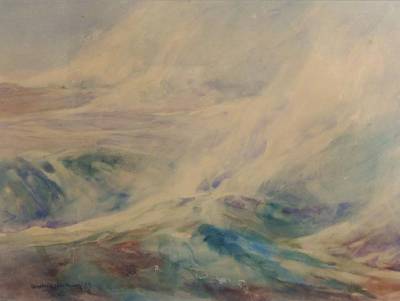
Ocean Waves by Woodbury
I'm going to be giving a free talk/lecture on Woodbury and the Ogunquit school at the York, ME Art Association on Saturday, September 7 from 7-8 p.m. and again on Monday, September 9 from 8-9 p.m. at the Manchester Art Association in Bedford, NH. It's an overview of Woodbury's life and work with an emphasis on how the "art of seeing" philosophy informed his work and how it can inspire today. You can download the slideshow as a PDF here.

All of this isn't intended to teach people to paint like Woodbury, of course. But the spirit of Woodbury's views provides jumping-off places for precisely, I think, what so many artists are looking for: inspiration for fresh, non-formulaic seeing and painting. 

It also feels like paying respect to one's predecessors. And really, it's just great to be painting outside in a place as beautiful as Ogunquit and to be "doing art history" in a way that treats it as a living thing.


Saturday, August 17, 2013

An Exercise in Expressiveness

I recently had a chance to try out some new exercises with two different groups of painters in classes on Cape Cod and at Star Island. The site of a practically untouched 1870s hotel, Star Island is part of the Isles of Shoals, a group of rocky yet beautiful and timeless islands lying 10 miles off the New Hampshire coast.

A painting of mine of the cliff known as
"Miss Underhill's Chair" on Star Island
In one exercise, the challenge was to paint a wholly expressive, abstract interpretation of the environment. The exercise started with a meditative walk in which we tried to be wholly present and to soak up impressions and "notice what we noticed" - a flash of color, the sweep of a cloud, the jut of rock or a root.

Next we returned to the studio and purposely did not paint anything that looked like the location. Armed only with our fresh impressions and memories, we specifically painted not what we saw but what we felt - not our ideas about what the physical place looked like but non-objective, expressive corollaries of the sensations we received from being there.

The point was not to make a masterpiece but to tap into something genuine. Even if the painting "failed" as traditional Western art, it would succeed in its truth and each artist's painting would truly be his or her own.

As it turned out, many of these paintings were not only expressive but also extraordinarily "good" paintings - exciting and surprising works conveying palpable moods and unique perspectives.

Finding and expressing one's heart's truth in painting is a mysterious, blindfolded affair; so much of it comes from parts of us that are inaccessible to rational thought. But we can control what we don't do - we can refuse the rational mind's insistence on what makes a "good composition," we can get around the rule of thirds, the rules of perspective, color theory and proportion.

I think it's probably a good idea sometimes to slip out the back door of the expected and the received and see what happens.